RAIN
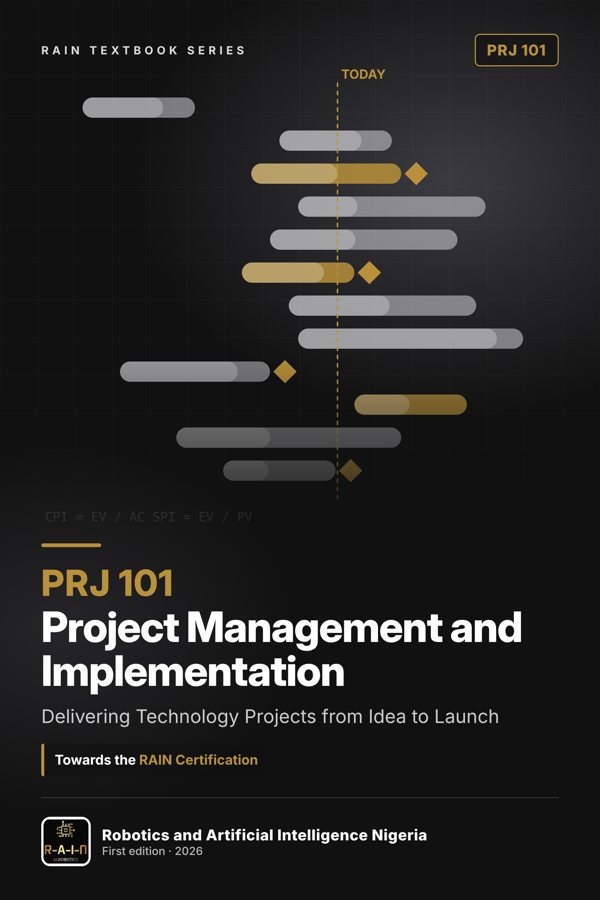
Cover of PRJ 101 Project Management and Implementation

PRJ 101

Project Management and Implementation

Delivering Technology Projects from Idea to Launch

Every working engineer, programmer and founder spends much of their time on projects: a robot to build for a client, an app to ship by a date, a research prototype to demonstrate, a product to launch. Technical skill decides whether the thing works; project skill decides whether it is finished, on time, within budget, and what the people paying for it actually needed. Most failed technology projects fail for project reasons rather than technical ones: unclear goals, scope that grows without control, optimistic estimates, risks that nobody listed, teams that do not talk. This book teaches the methods that prevent those failures, with the same rigour as the technical courses: the estimates are derived, the schedules computed, the budgets tracked by formula, and every method is applied to the kinds of project that RAIN trainees carry out.

21 chapters in 6 parts, 274 pages. Editor-in-Chief: Olusola Sayeed Ayoola. Published by RAIN, Ibadan, 2026.

Contents

Open a chapter to see its sections. Each chapter ends with a QR code for its free assessment.

1What a Project Is
  • 1.1 Projects, programmes and operations
  • 1.2 The project life cycle
  • 1.3 The triple constraint: scope, time and cost
  • 1.4 Roles: sponsor, project manager, team and stakeholders
  • 1.5 Case study: how big should the robot-kit team be?

Take the Chapter 1 assessment

2Starting a Project
  • 2.1 Problem statements and business cases
  • 2.2 Project charters
  • 2.3 Stakeholder analysis and engagement
  • 2.4 Feasibility: technical, economic and operational
  • 2.5 Case study: the business case for a farm soil-moisture kit

Take the Chapter 2 assessment

3Requirements and Scope
  • 3.1 Gathering requirements: interviews, observation and workshops
  • 3.2 Functional and non-functional requirements; user stories
  • 3.3 Work breakdown structures
  • 3.4 Scope creep and change control
  • 3.5 Case study: scoping the robot kit's first release

Take the Chapter 3 assessment

4Scheduling
  • 4.1 Activity definition and estimation
  • 4.2 Network diagrams and the critical path method
  • 4.3 Gantt charts and milestones
  • 4.4 Schedule risk and resource levelling
  • 4.5 Case study: scheduling the robot kit

Take the Chapter 4 assessment

5Cost and Budget
  • 5.1 Cost estimation and budgeting
  • 5.2 Earned value management: PV, EV, AC, CPI and SPI
  • 5.3 Procurement and vendor management
  • 5.4 Case study: tracking the robot kit's budget

Take the Chapter 5 assessment

6Risk and Quality
  • 6.1 Risk identification and the risk register
  • 6.2 Probability-impact analysis
  • 6.3 Quality planning, testing and acceptance
  • 6.4 Health, safety and environment on hardware projects
  • 6.5 Case study: the robot kit's risks and acceptance testing

Take the Chapter 6 assessment

7The Software Development Life Cycle
  • 7.1 Waterfall, V-model, iterative and agile models
  • 7.2 Requirements, design, build, test, deploy and maintain
  • 7.3 Defects and the cost of quality
  • 7.4 Delivering value early
  • 7.5 Documentation that teams actually use
  • 7.6 Case study: quality and delivery choices for the LMS exam feature

Take the Chapter 7 assessment

8Agile and Scrum
  • 8.1 Agile values and principles
  • 8.2 Scrum roles, events and artefacts
  • 8.3 Kanban
  • 8.4 Estimating with story points and velocity
  • 8.5 Case study: forecasting the LMS release and limiting work in progress

Take the Chapter 8 assessment

9Teams and Communication
  • 9.1 Team formation and roles
  • 9.2 Meetings, status reports and dashboards
  • 9.3 Conflict and decision making
  • 9.4 Remote collaboration tools
  • 9.5 Case study: decisions, meetings and time zones in the LMS team

Take the Chapter 9 assessment

10Tools for Project Teams
  • 10.1 Trello, Jira and GitHub Projects
  • 10.2 Version control in team projects
  • 10.3 Weekly project logs
  • 10.4 Case study: tools data for the robot kit team

Take the Chapter 10 assessment

11Finding the Real Problem
  • 11.1 Is it really a problem?
  • 11.2 Understanding users, environment and culture
  • 11.3 Learning from domain experts and earlier attempts
  • 11.4 Using AI to find the problem
  • 11.5 Writing the problem statement
  • 11.6 Case study: tomato losses and the questions to ask

Take the Chapter 11 assessment

12Data for AI Projects
  • 12.1 Types of data
  • 12.2 Explicit and implicit data collection
  • 12.3 Annotating and cleaning data
  • 12.4 Data pipelines and storage
  • 12.5 Designing for cost, safety, compliance and ethics
  • 12.6 Bias in data collection
  • 12.7 Case study: the data plan for the wardrobe app and the tomato grader

Take the Chapter 12 assessment

13From Data to Model
  • 13.1 Analyse before you model
  • 13.2 Feature interaction and extraction
  • 13.3 Reducing dimensions with the SVD
  • 13.4 Where to compute: laptop, GPU, cloud, edge and TinyML
  • 13.5 Developing and testing the model
  • 13.6 Case study: analysing the wardrobe data and sizing the models

Take the Chapter 13 assessment

14Deploying and Securing AI Products
  • 14.1 Choosing the interface
  • 14.2 Server-heavy or client-heavy
  • 14.3 Reducing API calls and running costs
  • 14.4 Domains, hosting and data residency
  • 14.5 Securing the platform
  • 14.6 Case study: costing, availability and a dynamic password for the wardrobe app

Take the Chapter 14 assessment

15Defining and Designing Robot Systems
  • 15.1 Defining the problem and the environment
  • 15.2 Enclosures, IP ratings and field kits
  • 15.3 High-level and low-level design
  • 15.4 Subsystem designs
  • 15.5 Justifying the design mathematically
  • 15.6 Case study: designing a field station for heat, radio and loads

Take the Chapter 15 assessment

16Sizing, Sourcing and Building
  • 16.1 Power, batteries and cables
  • 16.2 Choosing motors and actuators
  • 16.3 Sizing a drone for payload and wind
  • 16.4 Bills of materials and sourcing parts
  • 16.5 Working with artisans and fabricators
  • 16.6 Printed circuit boards in Nigeria
  • 16.7 Using the waiting time well
  • 16.8 Case study: power, flight and purchasing for a farm robot

Take the Chapter 16 assessment

17Testing, Deployment and Maintenance
  • 17.1 Testing under real conditions
  • 17.2 Worst-case test beds
  • 17.3 Inspection and acceptance
  • 17.4 Designing for maintenance and updates
  • 17.5 Telemetry and feedback
  • 17.6 Projects for clients
  • 17.7 Case study: field testing and updating a fleet

Take the Chapter 17 assessment

18Monitoring, Control and Closure
  • 18.1 Tracking progress
  • 18.2 Handling issues and changes
  • 18.3 Closing a project and lessons learned
  • 18.4 Case study: control, change and closure on the robot kit project

Take the Chapter 18 assessment

19Turning Projects into Ventures
  • 19.1 Lean start-up and minimum viable products
  • 19.2 The business model canvas
  • 19.3 Pricing, costing and funding
  • 19.4 Intellectual property and registration in Nigeria
  • 19.5 Case study: from robot kit project to business

Take the Chapter 19 assessment

20Presenting and Documenting Your Work
  • 20.1 Technical reports and project write-ups
  • 20.2 Pitching and seminar presentations
  • 20.3 Building a portfolio and showcase entry
  • 20.4 Case study: improving a report, a pitch and a portfolio

Take the Chapter 20 assessment

21Final Project Guide
  • 21.1 Choosing a project
  • 21.2 Proposal, milestones and supervision
  • 21.3 Assessment criteria
  • 21.4 Submission and defence
  • 21.5 Case study: planning and assessing a final project

Take the Chapter 21 assessment

Order a copy

Printed copies are delivered anywhere in Nigeria or collected at RAIN in Ibadan; digital copies arrive by e-mail with your book owner code. We will reply with the price, delivery cost and payment details.

Schools and companies ordering several copies: put the number you need and we will quote.

Other RAIN textbooks

AIML 101 Building and Deploying AI ApplicationsAIML 111 Data Science with PythonAIML 112 Machine Learning IAIML 211 Machine Learning IIAIML 212 Deep LearningRDA 111 Product Design and Development

All the books