RAIN
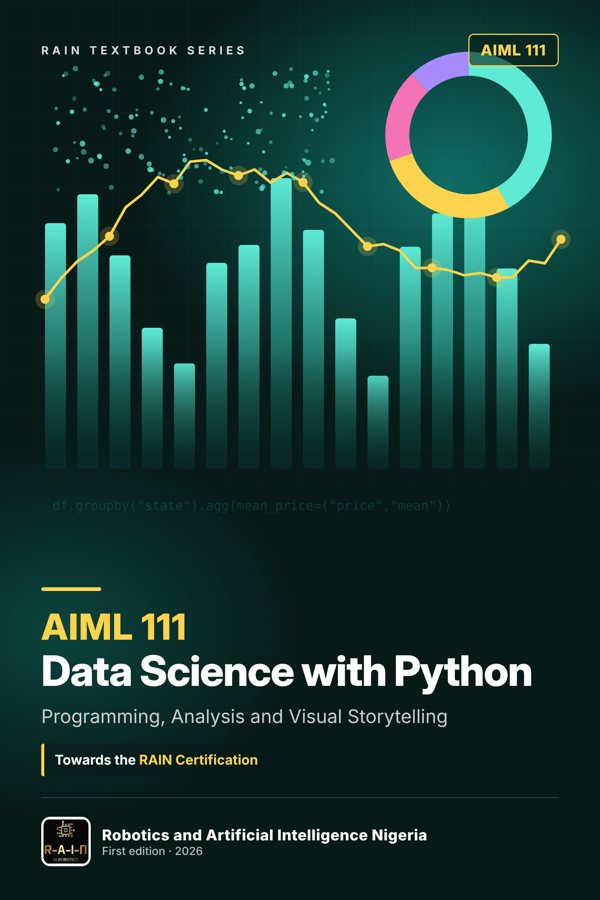
Cover of AIML 111 Data Science with Python

AIML 111

Data Science with Python

Programming, Analysis and Visual Storytelling

Every organisation now collects data: sales and stock records, applications and admissions, sensor readings, prices, clicks and messages. Very few use that data well. The gap is not a shortage of software. It is a shortage of people who can turn a vague question into a precise one, get the right data, clean it honestly, analyse it with sound statistics, and present the answer so that a decision-maker understands it and acts on it. This book trains you to be one of those people.

17 chapters in 5 parts, 277 pages. Editor-in-Chief: Olusola Sayeed Ayoola. Published by RAIN, Ibadan, 2026.

Contents

Open a chapter to see its sections. Each chapter ends with a QR code for its free assessment.

1The Data Science Process
  • 1.1 What data science is
  • 1.2 The CRISP-DM process
  • 1.3 Kinds of data
  • 1.4 Your working environment
  • 1.5 Reproducibility

Take the Chapter 1 assessment

2Python in Depth for Data
  • 2.1 Iterators, generators and lazy evaluation
  • 2.2 Single-pass statistics
  • 2.3 Functional tools and comprehensions
  • 2.4 Defensive data code
  • 2.5 Reusable modules
  • 2.6 Performance

Take the Chapter 2 assessment

3Numerical Computing with NumPy
  • 3.1 The ndarray
  • 3.2 Vectorisation and broadcasting
  • 3.3 Indexing and selection
  • 3.4 Linear algebra
  • 3.5 Random numbers and simulation

Take the Chapter 3 assessment

4Data Frames with pandas
  • 4.1 Series, DataFrames and the index
  • 4.2 Reading data
  • 4.3 Selecting, filtering and sorting
  • 4.4 Group-by: split, apply, combine
  • 4.5 Merging and joining
  • 4.6 Reshaping

Take the Chapter 4 assessment

5Data Cleaning and Preparation
  • 5.1 Missing data
  • 5.2 Duplicates, inconsistent categories and outliers
  • 5.3 Cleaning text
  • 5.4 Dates, times and time zones
  • 5.5 Constructing and encoding features
  • 5.6 Case study: cleaning a Nigerian market-price dataset

Take the Chapter 5 assessment

6Data from Databases and the Web
  • 6.1 Databases from Python
  • 6.2 Web APIs
  • 6.3 Web scraping
  • 6.4 Storing results

Take the Chapter 6 assessment

7Descriptive Statistics
  • 7.1 Measures of centre
  • 7.2 Measures of spread
  • 7.3 Shape
  • 7.4 Relationships between two variables

Take the Chapter 7 assessment

8Probability and Distributions
  • 8.1 Probability
  • 8.2 Random variables
  • 8.3 Common distributions
  • 8.4 The law of large numbers and the central limit theorem

Take the Chapter 8 assessment

9Inferential Statistics
  • 9.1 Sampling
  • 9.2 Confidence intervals
  • 9.3 Hypothesis testing
  • 9.4 Errors and power
  • 9.5 Case study: an A/B test of the application page

Take the Chapter 9 assessment

10Visualisation Principles
  • 10.1 Perception
  • 10.2 The grammar of graphics
  • 10.3 Choosing a chart for the question
  • 10.4 Honest charts
  • 10.5 Dashboards versus reports

Take the Chapter 10 assessment

11Plotting with Matplotlib, Seaborn and Plotly
  • 11.1 Matplotlib
  • 11.2 Seaborn
  • 11.3 Interactive charts with Plotly
  • 11.4 Exporting figures

Take the Chapter 11 assessment

12Spreadsheets for Analysts: Microsoft Excel
  • 12.1 Formulas and references
  • 12.2 Functions for analysis
  • 12.3 Lookups
  • 12.4 PivotTables and PivotCharts
  • 12.5 Power Query
  • 12.6 From Excel to Python and back

Take the Chapter 12 assessment

13Power BI
  • 13.1 Getting and transforming data
  • 13.2 Data modelling
  • 13.3 DAX
  • 13.4 Building and publishing reports
  • 13.5 Case study: an admissions dashboard

Take the Chapter 13 assessment

14Tableau
  • 14.1 Connecting to data
  • 14.2 Dimensions, measures and the shelves
  • 14.3 Calculations
  • 14.4 Dashboards and stories
  • 14.5 Power BI and Tableau compared

Take the Chapter 14 assessment

15Exploratory Data Analysis
  • 15.1 A systematic EDA checklist
  • 15.2 Univariate, bivariate and multivariate analysis
  • 15.3 Detecting data leakage early
  • 15.4 Communicating findings

Take the Chapter 15 assessment

16Introduction to Regression and Forecasting
  • 16.1 Simple linear regression
  • 16.2 Multiple regression
  • 16.3 Trends, moving averages and forecasting

Take the Chapter 16 assessment

17Capstone Analytics Project
  • 17.1 Defining the question with a stakeholder
  • 17.2 From raw data to dashboard
  • 17.3 Writing the analytical report
  • 17.4 Presenting to a non-technical audience
  • 17.5 The capstone project

Take the Chapter 17 assessment

Order a copy

Printed copies are delivered anywhere in Nigeria or collected at RAIN in Ibadan; digital copies arrive by e-mail with your book owner code. We will reply with the price, delivery cost and payment details.

Schools and companies ordering several copies: put the number you need and we will quote.

Other RAIN textbooks

AIML 101 Building and Deploying AI ApplicationsAIML 112 Machine Learning IAIML 211 Machine Learning IIAIML 212 Deep LearningRDA 111 Product Design and DevelopmentRDA 112 Practical Electronics

All the books