RAIN
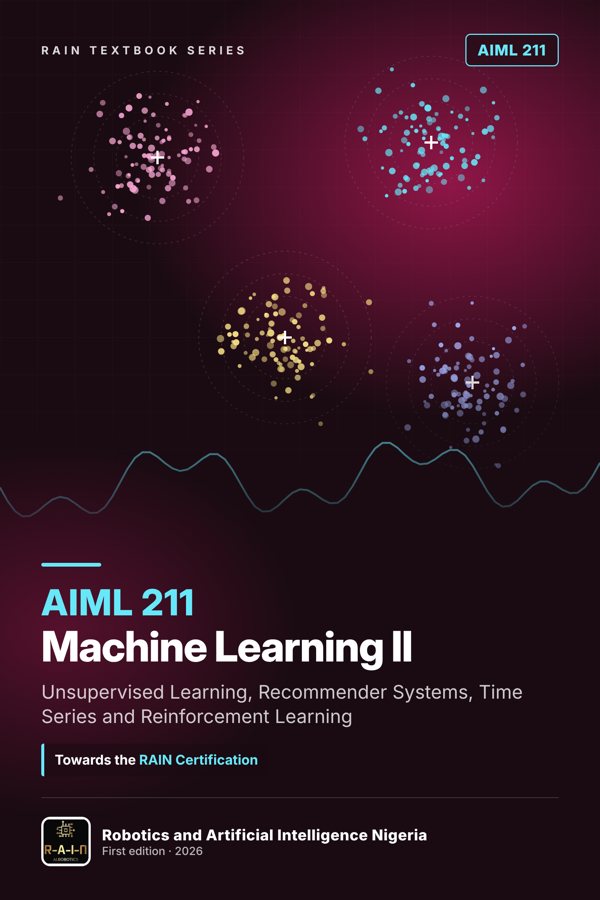
Cover of AIML 211 Machine Learning II

AIML 211

Machine Learning II

Unsupervised Learning, Recommender Systems, Time Series and Reinforcement Learning

Most of the data an organisation holds carries no labels. A supermarket knows what its customers buy but not which "kind" of customer each one is; a payment company sees millions of transactions but only a handful are ever confirmed as fraud; an electricity distributor records demand every day but must plan for days that have not happened yet; a robot must decide what to do next with no teacher telling it the right answer. AIML 112 taught supervised learning, in which every training example comes with the answer. This book teaches what to do when it does not: how to find structure in unlabelled data, how to recommend, how to forecast a series that unfolds in time, and how an agent can learn to act from rewards. It ends with the theory that explains when learning from data is possible at all.

15 chapters in 5 parts, 271 pages. Editor-in-Chief: Olusola Sayeed Ayoola. Published by RAIN, Ibadan, 2026.

Contents

Open a chapter to see its sections. Each chapter ends with a QR code for its free assessment.

1Clustering Foundations
  • 1.1 Similarity, distance and the clustering problem
  • 1.2 k-means
  • 1.3 k-means++ initialisation
  • 1.4 Choosing k
  • 1.5 Worked example: customer segmentation

Take the Chapter 1 assessment

2Hierarchical, Density-Based and Probabilistic Clustering
  • 2.1 Agglomerative clustering
  • 2.2 Density-based clustering
  • 2.3 Gaussian mixture models and the EM algorithm
  • 2.4 Evaluating clusters without labels

Take the Chapter 2 assessment

3Dimensionality Reduction
  • 3.1 Principal component analysis
  • 3.2 The singular value decomposition
  • 3.3 t-SNE and UMAP for visualisation
  • 3.4 Autoencoders

Take the Chapter 3 assessment

4Anomaly Detection
  • 4.1 Kinds of anomaly and of detection
  • 4.2 Statistical approaches
  • 4.3 Isolation forests and one-class SVMs
  • 4.4 Case study: fraud detection in mobile payments

Take the Chapter 4 assessment

5Association Rules and Market Basket Analysis
  • 5.1 Itemsets and rules
  • 5.2 The Apriori algorithm
  • 5.3 FP-growth
  • 5.4 Choosing and evaluating rules
  • 5.5 Case study: an Ibadan supermarket

Take the Chapter 5 assessment

6Foundations of Recommender Systems
  • 6.1 The recommendation problem
  • 6.2 Content-based recommendation
  • 6.3 Collaborative filtering
  • 6.4 Evaluating recommenders
  • 6.5 Implementation on the learning platform

Take the Chapter 6 assessment

7Matrix Factorisation and Latent Factors
  • 7.1 The latent-factor model
  • 7.2 Training by stochastic gradient descent
  • 7.3 Training by alternating least squares
  • 7.4 Implicit feedback
  • 7.5 Practical matters
  • 7.6 Case study: recommending RAIN courses

Take the Chapter 7 assessment

8Foundations of Time Series
  • 8.1 Components of a time series
  • 8.2 Stationarity and autocorrelation
  • 8.3 Transformations and differencing
  • 8.4 Case study: daily electricity demand

Take the Chapter 8 assessment

9Classical Forecasting Models
  • 9.1 Forecasting principles
  • 9.2 Exponential smoothing
  • 9.3 ARIMA models
  • 9.4 Case study: forecasting demand a week ahead

Take the Chapter 9 assessment

10Machine Learning for Time Series
  • 10.1 Forecasting as supervised learning
  • 10.2 Multi-step forecasting
  • 10.3 Models
  • 10.4 Case study: adding calendar and weather

Take the Chapter 10 assessment

11Markov Decision Processes
  • 11.1 The reinforcement learning problem
  • 11.2 Markov decision processes
  • 11.3 Policies and value functions
  • 11.4 Optimality
  • 11.5 Case study: a warehouse robot

Take the Chapter 11 assessment

12Dynamic Programming, Monte Carlo Methods and Bandits
  • 12.1 Dynamic programming
  • 12.2 Monte Carlo methods
  • 12.3 Multi-armed bandits
  • 12.4 Case studies: planning and learning

Take the Chapter 12 assessment

13Temporal-Difference Learning and Q-Learning
  • 13.1 TD prediction
  • 13.2 TD control: SARSA and Q-learning
  • 13.3 Multi-step bootstrapping
  • 13.4 Function approximation and deep reinforcement learning
  • 13.5 Reinforcement learning in the real world
  • 13.6 Case studies: cliffs and warehouses

Take the Chapter 13 assessment

14Statistical Learning Theory
  • 14.1 The learning problem
  • 14.2 Finite hypothesis classes
  • 14.3 Infinite classes and the VC dimension
  • 14.4 Beyond VC theory
  • 14.5 Experiments: what the theory predicts

Take the Chapter 14 assessment

15Capstone: Building Learning Systems Without Labels
  • 15.1 Framing problems without labels
  • 15.2 A worked system: learner engagement
  • 15.3 Deploying and monitoring
  • 15.4 The course project

Take the Chapter 15 assessment

Order a copy

Printed copies are delivered anywhere in Nigeria or collected at RAIN in Ibadan; digital copies arrive by e-mail with your book owner code. We will reply with the price, delivery cost and payment details.

Schools and companies ordering several copies: put the number you need and we will quote.

Other RAIN textbooks

AIML 101 Building and Deploying AI ApplicationsAIML 111 Data Science with PythonAIML 112 Machine Learning IAIML 212 Deep LearningRDA 111 Product Design and DevelopmentRDA 112 Practical Electronics

All the books